
Is your website working hard for your service-based business?
So you’re a woman running your own business, perhaps you’re a freelance nutritionist, a photographer or you have your own dog grooming shop. You’re doing an amazing job replying to emails, and consistently posting on you growing Instagram account alongside your day job. You also have a website, where you get the occasional enquiry, but it just isn’t pulling its weight. So you’re asking yourself, how can I attract more clients through my website?
Well I’m here to help. Below I’ll share 3 ways to update the website for your service-based business to generate more leads. I’ll also share why these work, and the problems they’ll help you tackle.
Let’s start by considering the reasons why websites are important for service based businesses and what they can do to drive your business forward if designed well.
How does an optimised website benefit a service-based business?

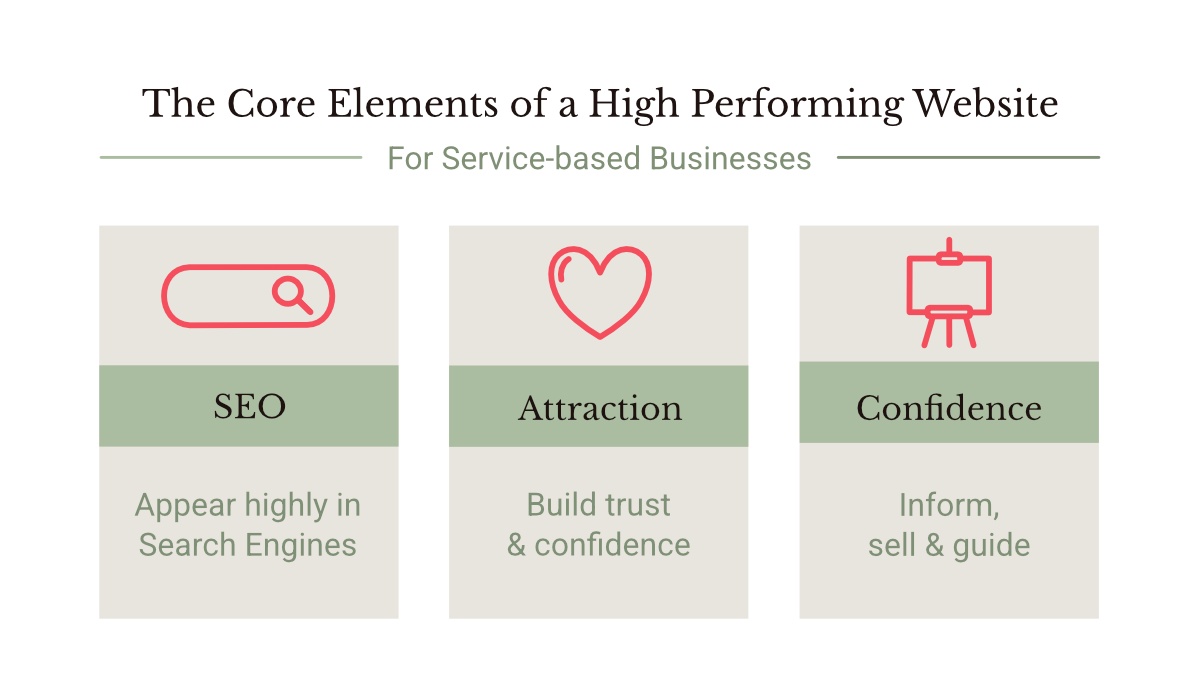
Websites that are designed well will widen your reach. Your website will enable your business to be found by people who are actively searching for what you offer, and not just those that happen to scroll past you.

They build trust before contact. For many people, your website will be their first impression of your business. A clear, well-structured, and tastefully designed site signals legitimacy and professionalism, even for very small or solo businesses. It reassures visitors that you’re established, intentional, and reliable.

A good website guides; turning interest into action. Through clear structure, your website leads visitors from discovery to decision, helping them quickly understand who you are, what you offer, and how you can help. By building confidence through clarity and reassurance, it makes the next step feel obvious and easy.
Ok, so we’ve touched upon how a good website can help your service based business, but how can you know when it’s time for an update?
How do I know if I need to update my website?
If you’re not sure whether the website for your business is ready for an update, let’s consider a simple (and very important) metric - how much traffic it’s getting.
To do this, you’ll need to log into your site (i.e. as admin) and take a look at your stats. If your website is built on WordPress, you may have a Google Site Kit dashboard that provides what you need. If you use Squarespace, you can check out the Analytics report. Take a look at the stats that show how many clicks your website is getting and how long they’re staying on your site for. These may suggest one or more of the following:

Your website isn’t getting enough clicks or views.
It isn’t retaining people once they’ve clicked on.
They’re staying long enough to look around but aren’t taking the next step to get in touch.
To help gather more information, ask your clients how they found you. What proportion have found you via your website? If you think there’s room for improvement and you’d like to know 3 ways to improve your website so that it gets your service-based business more enquiries, then read on. Let's first consider what may be causing these issues.
Why is my website not generating enough leads?

SEO
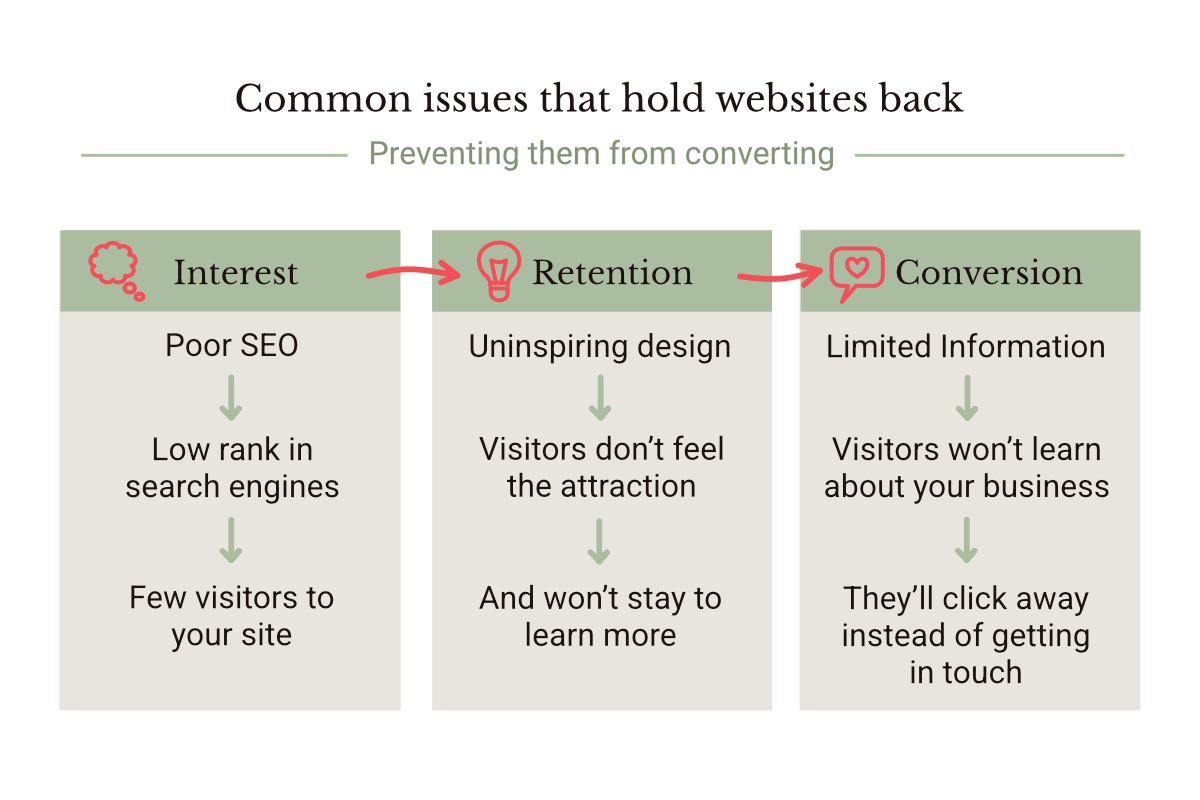
If you aren’t getting enough leads through your website, then there is likely some work you can do on your SEO. SEO stands for Search Engine Optimisation, and can be described as how well your website is designed to rank highly in search results. If poorly optimised, your website won’t be appearing high enough in search results when people are searching for something relevant. This will impact the number of people that discover your website, and so how many have the chance to become leads.
People will rarely click past the first or second page when searching in google (or any other search engine for that matter) before they find what they’re looking for, or alter their search phrase. For this reason, you need your website to rank highly. Your ranking will be determined by Googles’ assessment of your websites’ quality and relevance to the search. There are many factors that contribute towards your SEO, but amongst the easiest to work on are quality of images, headings and information.

Attraction
Perhaps your website is ranking highly enough in search engines, and people are clicking onto your website, but they’re just not staying there for long. Why is this?
Well, it may be that visitors just aren’t feeling the attraction. Whether this is due to large chunks of text making the information an effort to read, or blurry images that suggest no attention to detail. A poorly designed site can lead visitors to believe that, like the website, the business lacks skill and professionalism. In these cases, they won’t want to continue looking around your site to learn about your services, and they won’t bother getting in touch.
So let’s aim for a website that is both visually attractive, easy to read, and portrays a style that as accurately represents your business.

Confidence
Finally, let’s consider how much confidence your website is igniting in your business. Maybe people are clicking onto your site and finding it intriguing and attractive enough to stay and look around, but is there enough information to convince them that your business is the right fit for them? Have they been shown what they need to be able to understand who you are and what you do? Are they clear on the next steps to take to move forward?
Hopefully you have an idea of where your website is falling short. It would be helpful to know, but don’t worry if you don’t. All the tips I provide below will help you with all three. So, let’s dive into my 3 website improvements that will help your service-based businesses get more enquiries.
1.
Review your Images
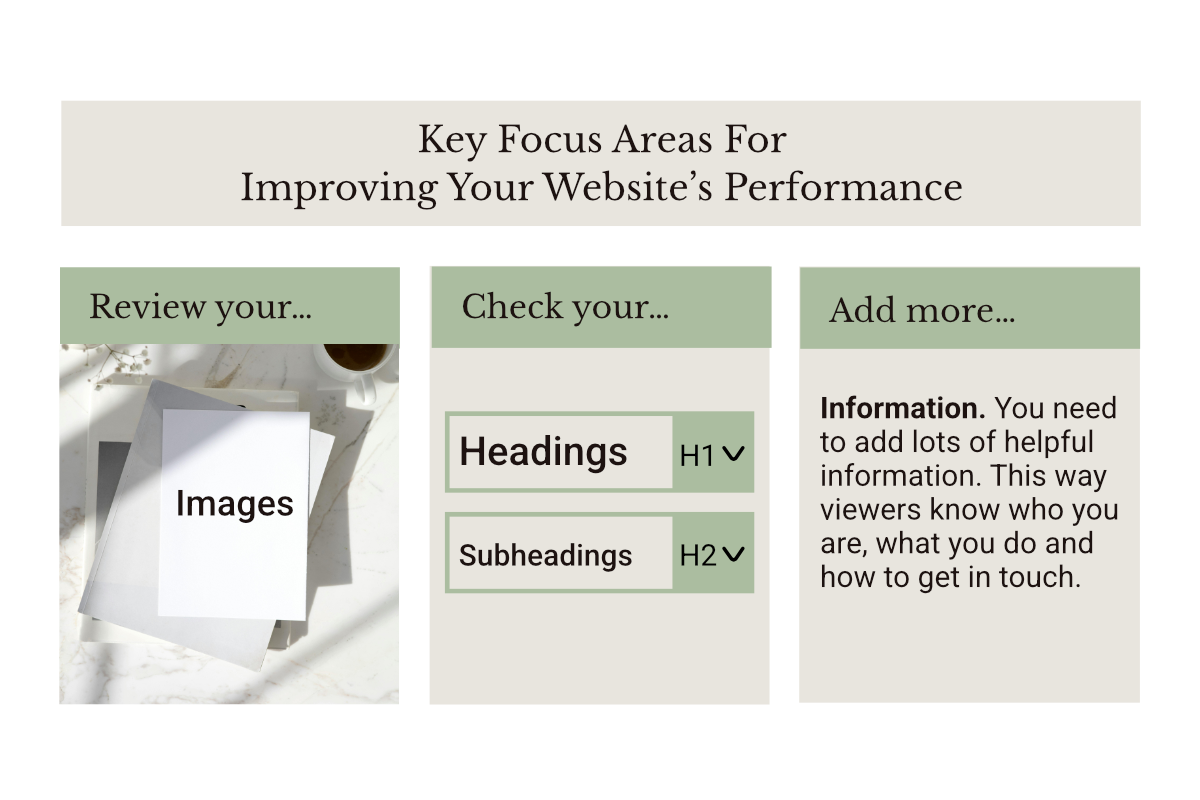
The first step is to take a look at the images you use on your site. We’re going to assess the quality and relevance of the photos, icons, and schematics in your website.
Images are important on a website because they are one of the first things we notice when we click onto a new site. They add visual interest and style to a website that no amount of text could ever replace. They enable us to get a feel for the business and the type of audience they serve. They say “A picture is worth a thousand words”, and this is of course very true. You just need to make sure it prompts the right words!
Does every service based website need images or are there exceptions?
Some businesses are easier to show in images than others. For example a hairdresser can show photos of designs they’ve styled, but it’s not quite an easy for a psychiatrist to illustrate their work. So does this mean they can skip images? In my opinion, no - you can still include imagery that helps the client get a feel for your business. For example photos of the calming space where you work, or a portrait of you can help build confidence and trust.
My suggestions for improving the images on your website

Make sure all images are clear and high quality. Replace any that are unintentionally blurred or grainy.
Remove any images that are irrelevant to your business, especially those that are clearly stock or AI imagery. Aim to use authentic images created specifically for your business.
Only include images that have a purpose, showing your products, your skills, or your style - intentionally setting the tone for your business.
2.
Check your Headings
Headings do far more than you may realise. They help viewers navigate your website - finding the content that is relevant to them and answers their questions. They break up paragraphs of text, making them easier and more enjoyable to read. Headings are also a great way of upgrading your SEO. Let’s dig into this further.
Where should I include headings?
You’ll already realise that every page should have a heading at the top. These should be set to H1 - this enables search engines to recognise page headings so that it can understand what your site is about and what it contains.
Within each page, you should also have multiple subheadings. You may set these to H2 (or H3, H4 etc if you want to include a hierarchy of headings). Subheadings break up the sections of your page, making it clear to the reader what each section is about. Having subheadings that are clear and descriptive will also enable search engines to recognise when your site is relevant to the phrases being entered by users.
My suggestions for getting the best out of headings
Update your headings so they include words or phrases that your ideal customers are actually googling (we call these ‘keywords’). As an example, a baker could aim to use headings like:
“Decorative birthday cakes for young children” or “Healthy sourdough bread made to order”.
Rather than something generic like “Birthday Cakes” or “Bread”.
If you have a lot of text on your site (which ideally you should), break it up with subheadings. They will improve readability and give search engines more context, which is great for SEO.
3.
Add more Information
To accompany your intentionally selected images and descriptive headings, you also need to include plenty of information for your visitors (and search engines!) to read.
What information should I include on my website?
Share what makes your business great so visitors have a clear reason to get in touch or purchase from you. This is your chance to tell visitors who you are, so make the most of it! Tell them your story, finishing on why you do the work you do. Provide your background, so they can see that you’re experienced and skilled. Make it clear who your customers are and how you have helped others.
If you can, demonstrate your expertise with snippets of helpful information. You could do this at the top of your services or product pages, or even in a blog. These won’t just demonstrate your skills to readers, but also to search engines. They show you’re knowledgeable in your field, and can provide value to those searching.
My suggestions for adding enough information
Try to include words and phrases that you know your customers will be searching. This will contribute towards ranking more highly in relevant searches and building trust with the reader.
Add genuine testimonials to show how you’ve helped previous customers.
Finally, make it really clear and easy for them to take the next step, whether that's how to make a purchase or how to contact you.
If you have a lot of text on your site (which ideally you should), break it up with subheadings. They will improve readability and give search engines more context, which is great for SEO.
Ready to put these changes into action?
We’ve looked at three practical ways to improve your website’s performance as a service-based business. By making better use of images, headings, and information, your website can attract the right visitors, keep their attention, and guide them towards becoming clients.
This is because the updates will help make your website more visually appealing, so visitors stay longer and get a real feel for your business.
They will also help build trust, so people feel confident choosing you.
And they’ll support your SEO, helping your website show up higher in search results when the right people are looking for what you offer.
If you’d like support applying these ideas to your own website, I offer thoughtful, strategy-led web design for service-based businesses. You’re welcome to get in touch to chat about how we could improve your site together